
Liquid-cooled LFP chemistry
Intelligent liquid cooling keeps the temperature difference between battery cells below 4°C, which significantly extends their service life.
We design, engineer, install, and operate large-scale battery systems that stabilize the power grid and generate recurring revenue through ancillary services and arbitrage — from compact cabinets to industrial container parks.
A battery system from Meganet is not just backup — it is an active market participant that continuously finds the most valuable application.
Participation in FCR, aFRR, mFRR, and FFR ensures stable earnings independent of spot market prices.
The facility charges when prices are low and sells power when prices are high.
Ensures security of supply and relieves your grid during peak loads.
A typical Meganet battery system — key technical figures for a single container module. Scales linearly from one to multiple modules depending on the project size.
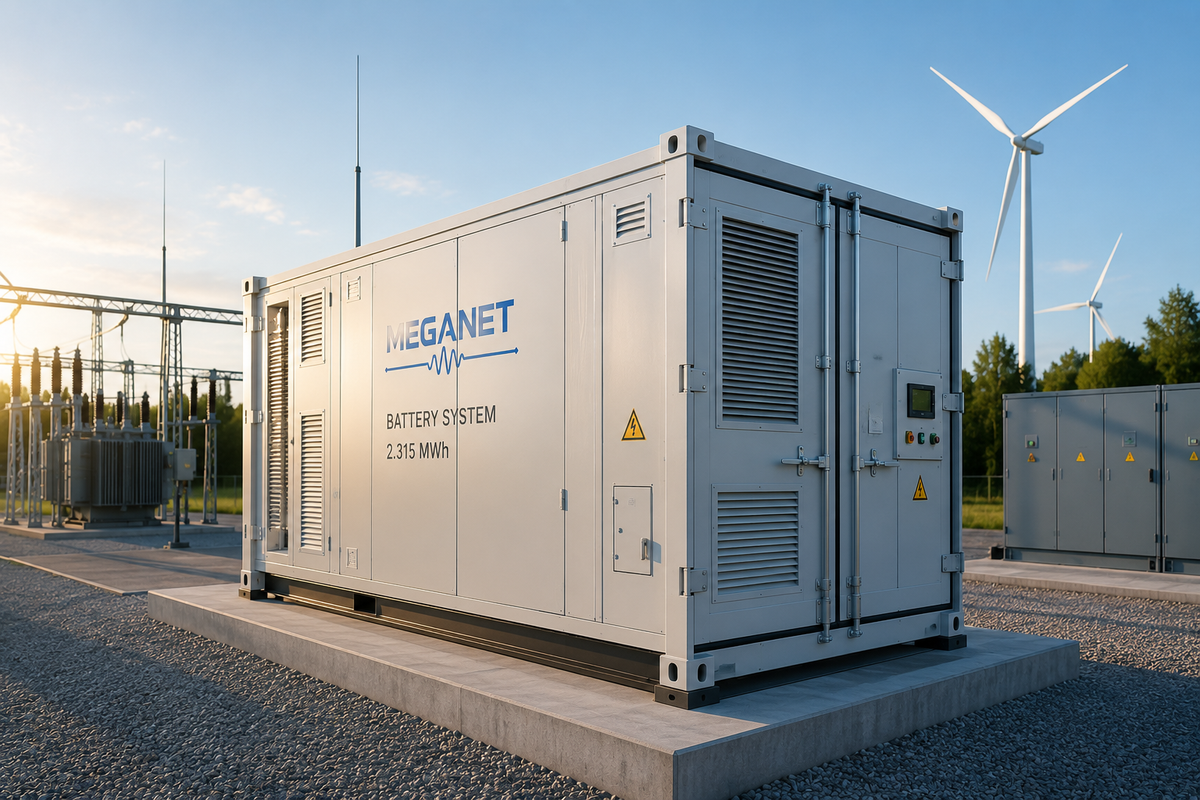
Intelligent liquid cooling keeps the temperature difference between battery cells below 4°C, which significantly extends their service life.
Outdoor steel container with IP54 system protection and operation throughout the entire Danish climate range, all year round.
Actively balancing battery management at the cell and rack level, integrated with Meganet's own VPP and SCADA platform.
Fully pre-installed and factory-tested prior to delivery. Connects directly to the low-voltage grid without further modification.
Response time under 1 second makes the plant suitable for FCR, aFRR, and other time-critical system services.
Aerosol-based fire suppression (FK-5-1-12), gas detection (CO/H2), and automatic emergency disconnection as standard in all modules.
All operational data streams in real-time to Meganet's control center, which monitors and optimizes the facility around the clock.
Designed for over 15 years of commercial operation with more than 78% remaining capacity after 10 years of operation at normal cycle frequency.
Documented efficiency: 93.86% single-trip and 88.11% round-trip efficiency, measured on 314Ah LFP cells at 8,000+ cycles.
Certifications and standards
A battery system is a long-term investment. Therefore, safety, thermal management, and continuous monitoring are built into the system from day one — not something added later.
Each container module is equipped with aerosol-based fire suppression (FK-5-1-12), continuous gas detection (CO/H2), and automatic emergency disconnection, which isolates any affected module without impacting the rest of the facility.
At a normal cycle frequency, the cells typically retain over 78% of their original capacity after 10 years of operation, and the system is designed for a commercial lifespan of over 15 years, supported by active liquid cooling and cell balancing.
All operational data flows in real-time to Meganet's control center. Scheduled service and any deviations are identified before they impact the plant's earnings or availability.
All Meganet battery containers are built on the same field-tested platform — only the number of modules and the footprint change. Two models cover most needs: the standard container (1,000 kW / 2,315 kWh) for large areas and industrial or grid-scale facilities, and the compact Flex (125 kW / 261 kWh) for space-constrained locations and smaller commercial properties.
Outdoor steel container with IP54 system protection, designed for year-round operation in the entire Danish climate range.
Fully pre-installed and factory-tested prior to delivery. Connects directly to the low-voltage grid without further modification.
From a single module to an entire battery park — the containers are connected according to the same principle, regardless of the size of the project.
In addition to system services and arbitrage, the battery is a flexible resource for the individual company — it reduces capacity tariffs, secures critical operations, makes better use of self-generated power, and can postpone expensive grid expansions.
The battery clips your power peaks, allowing you to avoid expensive peak load tariffs and reduce your subscribed grid connection capacity.
In the event of a power outage, the system ensures the continued operation of critical processes until normal supply is restored.
Surplus production from private solar or wind installations is stored and used when it is most valuable, rather than being sold cheaply.
In addition to your own needs, the facility can simultaneously bid into FCR, aFRR, mFRR, and FFR — and generate revenue independently of your own consumption pattern.
The system charges when electricity prices are low and sells or uses the power when they are high — an additional revenue stream alongside your operational needs.
By peak shaving, an expensive upgrade to your grid connection can often be postponed or avoided entirely.
An industrial battery changes how your business is exposed to the grid and the market.
There is no single right model — the right one depends on your capital strategy, risk appetite, and how much you wish to invest yourselves.
I own the facility 100% and receive all earnings from system services, arbitrage, and my own savings directly. Meganet handles design, installation, and operation on your behalf.
You and Meganet share the investment and earnings in a split that matches your capital strategy — a model that lowers your initial investment while you still share in the returns.
Meganet fully owns and finances the facility, places it on or at your location, and you receive a fixed share of the earnings — without tying up any capital yourself.
Based on a real-world installation and market foundation: the battery charges when electricity is cheap and discharges when it is expensive, and the default values below represent a system that is already profitable with a short payback period. Feel free to adjust the assumptions for your own installation.
The calculation is indicative and based on actual installation prices and a completed backtest against historical DK1 spot prices. Contact us for a specific calculation for your installation.
We map your consumption, flexibility, and market potential and prepare a concrete business case.
Our electrical engineers design the facility — technically and economically optimized for the location.
Our own electricians and marine engineers handle the entire installation, from foundation to grid connection.
Our VPP and EMS platform manages the facility 24/7 and continuously optimizes across markets.
It depends on your consumption, area, and goals — we size the system based on a specific potential analysis. If you have limited space, we also offer a compact 125 kW / 261 kWh FlexCube battery cabinet as an alternative to the large containers.
You choose for yourselves: full ownership, partial co-ownership with Meganet, or an operating agreement where we retain ownership and you receive a share of the earnings.
From analysis to commissioning, a typical project takes between 6 and 18 months, depending on size and grid connection.
The facility is certified according to a number of international standards, including IEC 62619, UN 38.3, IEEE 1547, UL 9540A, UL 1973, UL 1741, IEC 62477-1, EN 50549-1/2, CE-EMC, CE-LVD, and VDE 4110.
Yes. The foundation and grid connection can be designed for future expansion, allowing you to add more modules as the need grows.
It depends on your consumption patterns, capacity tariffs, and any on-site production. We will prepare a concrete business case based on your actual data before you commit.
Yes. In addition to peak shaving, arbitrage, and backup, the system can simultaneously participate in FCR, aFRR, mFRR, and arbitrage when it is not occupied by your own needs.
Meganet is responsible for all planned service and maintenance throughout the entire lifetime of the system, regardless of which ownership model you choose. Remote monitoring ensures that most deviations are detected before they impact operations.
LFP battery cells contain neither cobalt nor nickel and are among the most recyclable battery cell chemistries on the market. At the end of their service life, the cells are handled through approved recycling schemes.
Book en uforpligtende samtale med vores team. Vi kortlægger jeres potentiale og viser, hvad en løsning fra Meganet konkret kan betyde for jer.