
Charging station subsidy
Get an overview of subsidy percentages, location, public accessibility, charging power, and the most important pitfalls before your company applies for support for charging stations.
Grants
How charging stations, batteries, and system services are becoming part of the energy infrastructure of the future.
Denmark is in the midst of a historic transformation of its energy system. The electrification of transport, massive investments in renewable energy, and an increasing focus on energy security are fundamentally changing the way we produce, distribute, and consume power.
One of the most visible areas is the expansion of charging infrastructure for electric vehicles. However, this development is about much more than just more charging stations — and today there are several different grant pools, each with its own rules. Below, we review both the pool for publicly accessible charging stations and the newer pool for heavy road transport — two pools that are often confused with one another.
The Danish Road Directorate’s pool for publicly accessible charging stations
As part of the agreement on green transport from June 2021, a state pool of DKK 64.4 million was allocated for publicly accessible charging stations.
The pool was administered by the Danish Road Directorate and aimed to accelerate the expansion of charging infrastructure in Denmark. Support could be applied for by charging station operators, infrastructure partners, energy companies, and consortia and partnerships, with a particular focus on the motorway network, transport hubs, areas with seasonal load, and publicly accessible charging areas.
Interest in the pool proved to be massive. The Danish Road Directorate received 438 applications and 787 individual projects, granted support to 241 projects, and the total support amounted to approximately DKK 64.3 million. This clearly underlines how rapidly the market for charging infrastructure is developing.
The grant under this pool can be up to 25% of the total project costs for fast charging stations (50-149 kW) and ultra-fast charging stations (150 kW or more), and public accessibility must be maintained for a minimum of 5 years at the given location.
Grid connection has become one of the biggest challenges
Although investments in charging infrastructure are growing rapidly, many projects have encountered a new challenge: a lack of grid capacity. The Danish Road Directorate later chose to extend the pool by one year until December 31, 2026, partly due to long wait times for grid connections.
This is an important signal. The green transition is no longer just about installing charging stations — it is about the capacity and flexibility of the entire energy system. A modern charging park can in practice have the same load as a large industrial plant, which creates challenges regarding electricity grid strain, power peaks, security of supply, local bottlenecks, long processing times for grid connections, and expensive grid reinforcements.
This is where batteries and intelligent energy management become crucial solutions.
Batteries are becoming the natural extension of charging infrastructure
Future charging parks will increasingly be combined with battery systems that act as a buffer between the electricity grid and the charging infrastructure. This makes it possible to handle large power fluctuations much more intelligently — for example through peak shaving, where the battery supplies power during peak periods instead of drawing all the power directly from the grid.
The benefits are significant: lower strain on the electricity grid, reduced power charges, less need for grid expansion, faster implementation of projects, and better utilization of existing grid capacity. For many projects, batteries can be the difference between quick implementation and years of waiting for grid reinforcement.
Intelligent energy management is becoming essential
Batteries make it possible to store energy when power is cheap or when local solar production is high. The power can then be used when the electricity price rises, during high charging activity, when the grid is under strain, for system services, or as backup during unstable supply. Thus, the charging park becomes not just a consumption point — but an active part of the energy system.
System services create new revenue opportunities
Energinet continuously purchases reserves and flexibility to ensure stable operation of the electricity grid — including FCR, FCR-D, FCR-N, aFRR, mFRR, and FFR. As Denmark adds more wind and solar to the energy mix, the need for rapid regulation and flexibility increases significantly. Here, batteries have a huge advantage: they can react in milliseconds and are therefore ideal for stabilizing the electricity grid.
When batteries are integrated with charging infrastructure, it opens up possibilities for entirely new revenue streams — for instance, by relieving the grid, supporting ultra-fast charging, optimizing power purchases, providing system services, and participating in flexibility markets. This makes battery-integrated charging parks particularly attractive to investors.
Grant for green transition of heavy road transport (2026)
In addition to the pool for publicly accessible charging stations, there is a separate, newer pool targeted at the electrification of heavy vehicles: The Pool for the Green Transition of Heavy Road Transport 2026. It covers charging infrastructure for trucks — typically as depot charging (the company's own vehicles) or destination charging (locations with a high turnover of external trucks during delivery and pickup).
The grant percentage depends on the company size and whether the depot charger is also made periodically publicly accessible:
| Depot charging after February 18, 2026 | Small company | Medium-sized | Large |
|---|---|---|---|
| For own use only | 30% | 20% | 5% |
| Periodically publicly accessible | 40% | 30% | 10% |
In principle, there is a cap of DKK 4 million per company/group. The final amount depends on the commitment, eligible costs, and actual expenses incurred. If periodic public accessibility is chosen to obtain a higher grant, there must be public access for a minimum of 8 and a maximum of 12 hours per day, and this accessibility must be maintained for 4 years after commissioning.
Who can apply, and where should the charger be located?
The pool is targeted at private companies — public institutions cannot receive grants under it. For depot charging, the charger must be located on an area that the applicant has control over, and it must primarily be for own use (typical locations: depot, terminal, warehouse, distribution center). For destination charging, there must be a high turnover of delivery and pickup by external trucks at the location, and the charging facilities here must not be publicly accessible — only the grid connection itself is eligible for support in this track.
There is no general minimum requirement for charging power (kW) for depot charging — the power should instead be dimensioned according to charging needs, operating patterns, number of vehicles, and available grid capacity.
What can you apply for — and what not?
For depot charging, you can apply for the construction, installation, upgrading, or expansion of charging infrastructure — including equipment, grid connection, construction work, buffer batteries, relevant external services, and certain leasing/subscription agreements. For destination charging, only the grid connection is supported. Refundable VAT, interest on debt, commissions, and general operating expenses (electricity, maintenance, insurance) are not eligible for support.
How to apply
- Choose the right type of project. First, clarify whether it concerns depot charging, destination charging, or the public charging station pool — this dictates the grant percentage, location, access requirements, and which expenses can be supported.
- Clarify company size. The grant percentage depends on whether the company is small, medium-sized, or large — corporate affiliations may be significant.
- Get control over location and land access. The applicant must be able to document control over the area where the charging infrastructure is to be established.
- Obtain budget and quotes. A concrete, documented budget is required — use the relevant budget template from the Danish Road Directorate.
- Submit the application before the project starts. Project activities must not have commenced before the Danish Road Directorate has received the application — expenses incurred too early may fall outside the grant basis.
- Await commitment and follow the terms. After approval, the project must be carried out according to the approved budget, location, and the terms stated in the commitment. Changes to the site, budget, or technical solution must be approved before they are implemented.
In the 2026 rules, the application period is divided into two: the first period runs from February 4 to February 17, 2026, inclusive (lower grant percentages), and the second period runs from February 18 to September 30, 2026, inclusive (increased grant percentages). Applications are processed on a first-come, first-served basis.
Checklist before application
- Clarify whether you are applying for depot charging, destination charging, or the public charging station pool.
- Determine company size, as it dictates the maximum grant percentage.
- Document control over the area where the charging infrastructure is to be installed.
- Dimension the charging power according to operations, fleet, time windows, and grid capacity.
- Avoid starting project activities or incurring expenses before the application is submitted.
- Apply for a project change if the location, budget items, or technical solution change after the commitment.
Important: two pools are often confused
The pool for heavy road transport and the pool for publicly accessible charging stations have different rules regarding power requirements, grant percentages, and requirements for public accessibility. It is worth clarifying early in the process which pool is relevant for your specific project — a wrong assumption here could mean rejection or a significantly lower grant than expected.
Grid stability becomes a critical societal function
Previously, the majority of power came from large, central power plants with high stability and natural inertia. The energy system of the future will be far more dynamic: wind, solar, electric vehicles, heat pumps, and data centers are creating a more complex energy grid with large variations in both production and consumption.
This increases the need for rapid regulation, local flexibility, intelligent management, energy storage, and digital monitoring. Batteries therefore become not just economically interesting — they become an important part of the grid stability of the future.
Public grants accelerate development
Support schemes like the Danish Road Directorate’s pools play a central role in the development of the energy system of the future. They reduce the risk of investments and make it possible to accelerate the expansion of charging infrastructure, battery systems, energy storage, smart grid solutions, flexibility technologies, and intelligent energy management — while simultaneously attracting infrastructure investors, energy companies, charging operators, software companies, battery developers, and technology suppliers.
Conclusion
The Danish Road Directorate’s support pools for charging infrastructure clearly show how quickly the green transition is accelerating in Denmark. However, they also show that the challenge of the future is not just about more charging stations — it is about grid capacity, energy storage, flexibility, intelligent management, and stability in the electricity grid.
This is where batteries and system services become central elements in the energy infrastructure of the future. For companies, this opens new revenue opportunities. For investors, it creates access to a market driven by long-term structural growth, critical infrastructure function, electrification, digitalization, green transition, and the increasing need for grid stability.
At Meganet, we follow this development closely and help companies and investors identify the opportunities that arise as the energy system becomes more flexible, digital, and market-based — whether through the public charging station pool or the pool for heavy road transport.
The rules in brief
This is the government subsidy that all of Meganet’s investment cases (Dual Asset, Backup Flex, Wind Turbine + BESS, etc.) rely on. The figures below represent the complete, updated regulation — the other cases refer to this instead of repeating it.
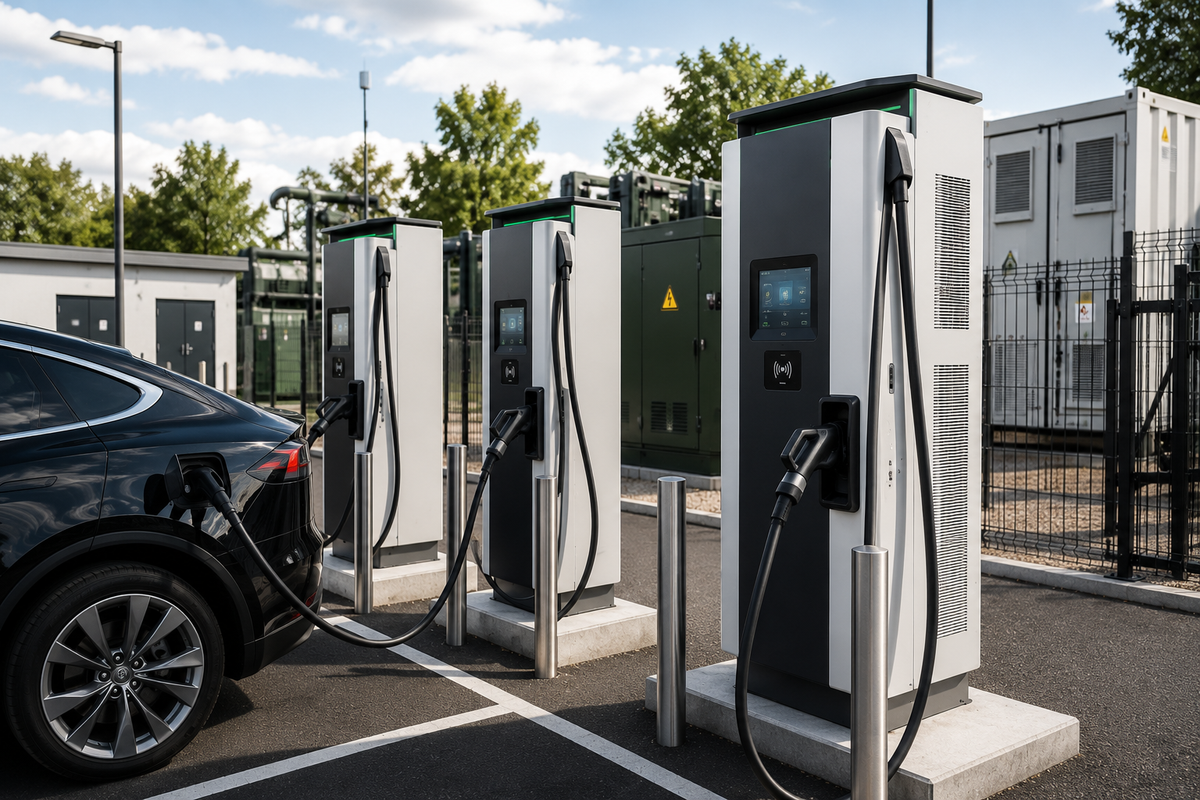
Good to know about charging station subsidies
Is the charger allowed to be in a locked area?
Depot charging can be located on company premises, but if applying under the rules for periodic public accessibility, the public must be able to use the charging facilities during the approved timeframe.
May the charger be moved to another location?
Not without approval. Any change of site or location must be requested as a project amendment and approved by the Danish Road Directorate before the change is implemented.
Can destination charging be publicly accessible?
No. For destination charging, the terms state that the charging facilities must not be publicly accessible, and the eligible costs include only grid connection.
Who is eligible to apply for the grant?
Businesses, farms, commercial properties, and wind turbine owners that install a publicly accessible charging station as part of a larger energy project (e.g., a battery, load bank, or generator) typically qualify.
Is the fund still open, or has the money been spent?
The pool of DKK 64.4 million is largely fully allocated after 241 approved projects, but the deadline has been extended to December 31, 2026. We provide advice on the current status and any potential new application rounds upon request.
Get the correct subsidy model clarified
Book en uforpligtende samtale med vores team. Vi kortlægger jeres potentiale og viser, hvad en løsning fra Meganet konkret kan betyde for jer.