
Wind turbine + BESS — how to turn grid connection into a flexible revenue platform
Wind turbines are no longer just production facilities. With a BESS installation, load bank, and intelligent control, an existing wind turbine can be developed into a flexibility asset that both produces green power, provides system services, and utilizes grid capacity that otherwise stands unused for large parts of the year.
This is particularly relevant for wind turbine owners, as the grid connection is often one of the most valuable assets in the project.
The wind turbine's hidden value: the grid connection
A 1-2 MW wind turbine only produces full output for a limited part of the year's hours. The rest of the time, there is spare capacity in the grid connection — an unutilized potential for flexibility.
Where the classic model is: Wind turbine produces power → power is sold on the spot market, the modern model can be: Wind turbine + BESS + load bank + EMS → system services, regulation, spot optimization, and better grid utilization. This changes the entire business model.
From arbitrage to system services
Many associate batteries with arbitrage — that the battery is charged when power is cheap and discharged when power is expensive. Arbitrage can still be relevant, but it should not be the main business case.
In modern BESS projects, the primary value typically lies in system services — the services used to keep the electricity grid in balance. Batteries are well-suited for this because they can react quickly and precisely, absorb and deliver power, and be controlled automatically via EMS and SCADA.
A concrete calculation: 2 MW wind turbine + 9 MWh battery
In a concrete analysis of a 2 MW wind turbine installation combined with a 9 MWh battery, the calculations showed the following gross revenues:
| Operating scenario | Annual gross revenue |
|---|---|
| Wind turbine alone | DKK 2.70 million |
| Wind + negative price arbitrage | DKK 3.51 million |
| Wind + extended spot optimization | DKK 4.18 million |
If one instead looks at system services on top of wind production, the difference becomes even clearer:
| Product | Total gross revenue incl. wind turbine |
|---|---|
| FCR | DKK 4.69 million |
| aFRR up | DKK 7.25 million |
| Best up-product strategy | DKK 8.11 million |
The result clearly shows that in many situations, system services can create greater value than traditional arbitrage alone.
Why BESS complements wind turbines
A BESS installation makes the wind turbine more flexible in three ways: the battery can be charged with local wind production and reduce dependence on purchases from the grid; it can provide upward regulation when the electricity grid lacks power; and together with a load bank, it can provide downward regulation when the electricity grid has too much production. The wind turbine thus becomes not just a passive producer, but an active flexibility resource.
Load bank: the overlooked key to downward regulation
A load bank is controllable electricity consumption — the facility can use power on command when the electricity grid needs downward regulation. In combination with a wind turbine, this provides great value because the opportunity arises to absorb surplus production locally, during negative electricity prices, for testing and pre-qualification, balancing, and local utilization of wind production.
In one of our concrete projects for an existing wind turbine owner, a 2 MW load bank is included together with a 2 MW BESS and an existing 2 MW wind turbine. The analysis assesses that the load bank is a central technical asset because it increases flexibility and the possibility for downward regulation.
System services require energy — not just power
It is not enough to say that a battery has 1 MW or 2 MW of power — one must also look at the energy capacity. If a facility, for example, needs to deliver 1 MW for 8 hours, it requires at least 8 MWh of usable energy. This is particularly important in relation to mFRR and LER status: batteries can be considered a Limited Energy Reservoir if they do not have sufficient energy storage to deliver the sold service in the required time.
In this project, the battery pack is dimensioned as approx. 4 MW / 9.26 MWh physical capacity, but software-limited to 2 MW active power at the grid connection point. The usable capacity at Beginning of Life is approx. 8.69 MWh — which provides a significant technical advantage: the facility can in principle cover 1 MW for 8 hours at start.
Why over-dimension the battery?
In this project, the solution consists of four battery containers of 1 MW / approx. 2.315 MWh each. The total physical pack is approx. 4 MW / 9.26 MWh, but the facility is controlled as a 2 MW flexibility installation at the grid connection point. This provides a better energy buffer, stronger SOC control, better opportunity for system services, lower risk of failure to deliver, better handling of battery degradation, and the possibility of mFRR 1 MW for 8 hours at BOL.
The decisive factor is therefore not just the “size” of the battery, but the relationship between power, energy capacity, grid limit, and market product.
EMS: the brain of the facility
When wind turbine, BESS, load bank, and charging stations are combined, control becomes crucial. The EMS system must ensure that the facility does not exceed the grid limit — if the wind turbine produces at the same time as the battery discharges, the export may become too high; if the battery charges at the same time as the load bank and charging stations use power, the import may become too high. Therefore, the entire energy point must be controlled as a whole, with SOC limits, bidding strategy, LER status, grid limits, measurement, alarms, automatic bid stops, and DataHub/SCADA integration.
This is where a BESS project goes from being hardware to becoming a controllable energy facility.
Prioritization: system services first, arbitrage as an optimization layer
In a modern flexibility project, the prioritization should be: system services first, SOC reserve for bid services, local wind charging, charging during low or negative price hours, load bank for downward regulation, and arbitrage when it does not weaken system services. The analysis concludes precisely that the base scenario should be sold as a system service project with strong energy reserves — not as a pure arbitrage case.
The financials: flexibility can surpass the wind turbine's base operation
An existing wind turbine can already be a healthy asset. The accounting figures for the existing wind turbine in this example show a result before depreciation of approx. DKK 2.20 million in 2025 and approx. DKK 2.13 million in 2024.
The new flexibility case is assessed to have an expected annual net earnings of approx. DKK 6.05-7.95 million after aggregator fees, fixed operating costs, and a moderate charging station contribution. This shows the difference: the wind turbine creates value through production, BESS and load bank create value through flexibility — and the combination can increase the value of the existing asset significantly.
The investment
In this project, the total investment for 2 MW BESS, 2 MW load bank, and 600 kW charging stations is estimated at approx. DKK 16.0-18.25 million excl. major grid contributions, land, financing, and potential ampere purchases. After an assumed 40% subsidy, the net investment is reduced to approx. DKK 9.6-10.95 million.
This gives an estimated simple payback period of approx. 1.2-1.8 years in the expected scenario after subsidy. The figures must of course be verified in each individual project, but they show the potential in utilizing an existing wind turbine as a platform for flexibility.
A smaller illustrative example: 1 MW battery + load bank + charging stations
In addition to the case above, a smaller, purely illustrative calculation example on a 1 MW scale can give a concrete impression of the figures behind a complete flexibility setup. Note: this is a separate, generic example — not the same facility as described above.
- Battery (BESS) — 1 MW / 4.63 MWh: LFP battery with response time under 30 ms. Can both regulate up and down and participate in FCR, aFRR, mFRR, and FFR.
- Load bank — 1 MW: Controllable electricity consumption that absorbs surplus power at low and negative electricity prices. Covers FCR-D down and mFRR down.
- DC charging stations — 300 kW: Prerequisite for the state project subsidy. Can itself provide downward regulation (FCR-D down, aFRR down) via OCPP 2.0.
| Investment item | Amount |
|---|---|
| Battery (BESS) 1000 kW | DKK 5,195,000 |
| Load bank 1000 kW | DKK 600,000 |
| Charging station 150 kW | DKK 300,000 |
| Container | DKK 150,000 |
| Electrical cabinet | DKK 300,000 |
| Project management & installation | DKK 350,000 |
| Total investment | DKK 6,630,000 |
| State subsidy (40%) | −DKK 2,652,000 |
| Net investment | DKK 3,978,000 |
| Expected annual net earnings | Amount |
|---|---|
| Gross system services | DKK 4,217,647 |
| Aggregator fee (15%) | −DKK 632,647 |
| Service agreement | −DKK 25,000 |
| Insurance | −DKK 40,000 |
| Net cash flow per year | DKK 3,520,000 |
| Depreciation per year (15 years) | −DKK 331,500 |
| Result before tax per year | DKK 3,188,500 |
This gives a payback period of approx. 22.6 months before subsidy and approx. 13.7 months after subsidy, with an estimated ROI of 603% over 15 years and a total 15-year net earnings of approx. DKK 27.95 million.
| Period | Net cash flow | Accumulated |
|---|---|---|
| Year 0 | — | −DKK 3,978,000 |
| Year 1 | DKK 3,520,000 | −DKK 458,000 |
| Year 2 | DKK 3,168,000 | +DKK 2,710,000 |
| Year 5 | DKK 2,309,472 | +DKK 10,436,752 |
| Year 10 | DKK 1,363,720 | +DKK 18,948,519 |
| Year 15 | DKK 805,263 | +DKK 22,980,132 |
Note: an annual reduction of 10% in net earnings has been included as a conservative sensitivity calculation in this example. All figures are preliminary decision-making figures subject to pre-qualification, market prices, grid constraints, subsidy approval, and supplier quotes — not a guarantee of future return.
Grid connection is the critical factor
The most important clarification is not just the battery price — it is the grid connection. The following must be clarified: export rights, import rights, metering structure, upward and downward regulation rights, transformer limits, need for ampere purchases, charging station capacity requirements, LER status, pre-qualification, EMS requirements as well as balance responsible party and electricity supplier. In this project, grid limit, LER, EMS, subsidy terms, and charging station grid are highlighted as the critical clarifications.Conclusion
BESS installations complement wind turbines because they utilize the existing grid connection better, create access to system service markets, and make the wind turbine an active flexibility facility. Arbitrage can still contribute, but should not be the main argument. The strong business case arises when wind turbine, battery, load bank, EMS, measurement, and market access are thought of as one single energy point.
At Meganet, we help wind turbine owners analyze, dimension, and realize BESS solutions where the existing grid connection is used more efficiently — and where value is shifted from pure power production to active flexibility.
Wind turbine + BESS in numbers
Key figures for a specific 1 MW wind turbine + BESS hybrid plant.
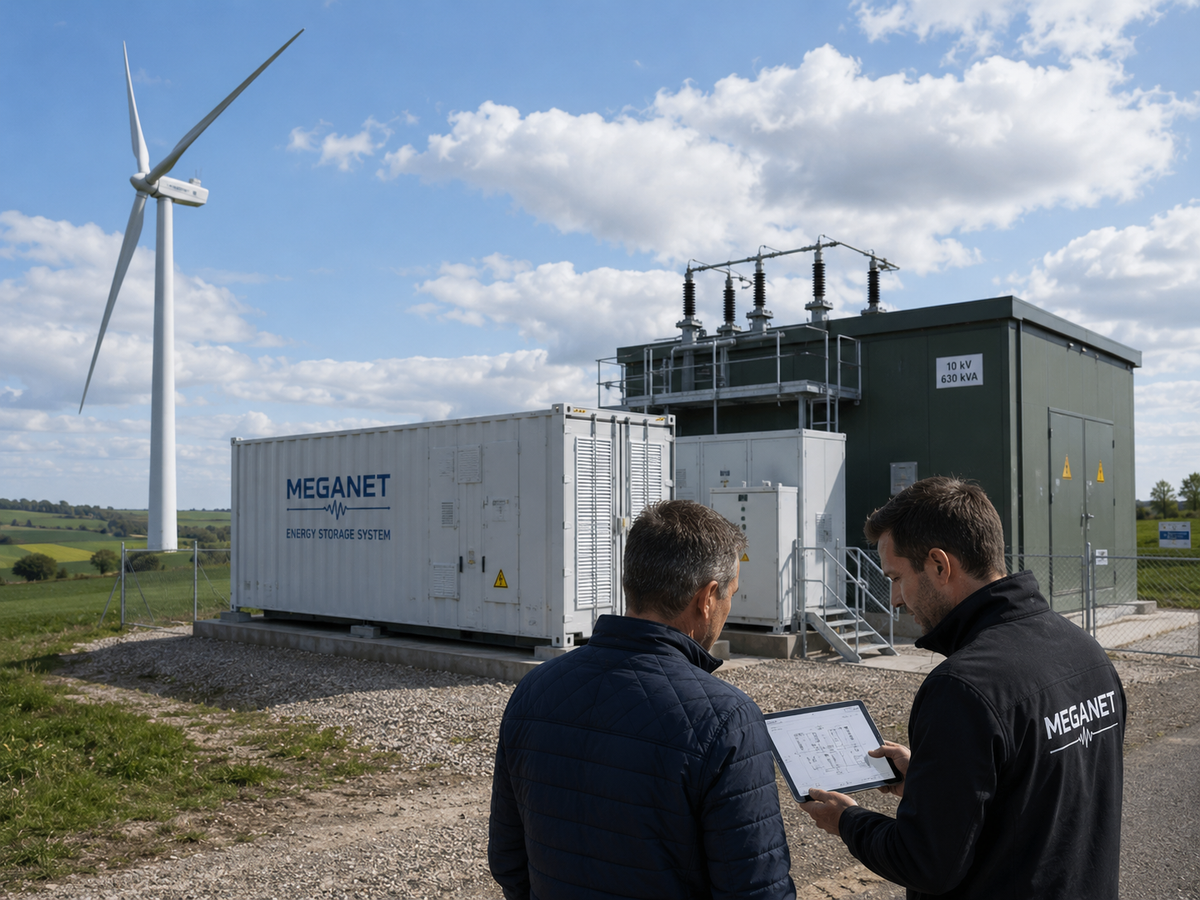
Wind turbine and battery interaction
Wind turbine
Produces power independently of market price — the battery makes production flexible.
Battery (BESS)
Charges at low price or surplus production, discharges at high price or upon market demand.
From production to market participation
Production from the wind turbine
The wind turbine produces power independently of the spot price. All production is recorded and integrated into the overall management of the facility.
Charging at a low price or surplus
The battery charges primarily when the spot price is low, or when the wind turbine's production exceeds the grid connection capacity and would otherwise be curtailed.
Discharge and market participation
The battery discharges during high-price periods or provides system services to Energinet, depending on where the market provides the best value in the given hour.
Investment and earnings (1,000 kW setup)
Based on a specific 1 MW wind turbine + BESS facility, including project management.
Investment
Annual earnings
40% subsidy of a total investment of DKK 6.63 million = approx. DKK 2.65 million, which reduces the net investment to approx. DKK 3.98 million. See the Subsidy page for the full rules and requirements. The figures are indicative and not a guarantee of future returns.
Regarding Wind Turbine + BESS
Does the case require a new wind turbine, or can an existing facility be used?
Both are possible. The case is based on an existing wind turbine where the battery is added as a supplement — but the solution can also be included in a new wind turbine project from the start.
How does this differ from the Spot Arbitrage case?
The spot arbitrage case focuses specifically on the price difference between charging and discharging times. This case looks more broadly at the entire interplay between wind production, grid connection, and the battery's role in both the price and system services market.
Is there a government subsidy for this case?
Yes, if a publicly accessible charging station is included in the project. See the Grant page for the full rules and requirements.
How is the battery sized in relation to the wind turbine?
We base our assessment on the turbine's production profile, the grid connection capacity, and the degree of historical curtailment to determine the battery size that provides the best ROI.
Can the setup also participate in the system services market?
Yes — the battery can switch between price optimization and participation in FCR, aFRR, and mFRR, depending on where the market provides the best value.
Are you considering wind turbine + BESS?
Book a non-binding meeting, and we will calculate the figures for your specific installation.